
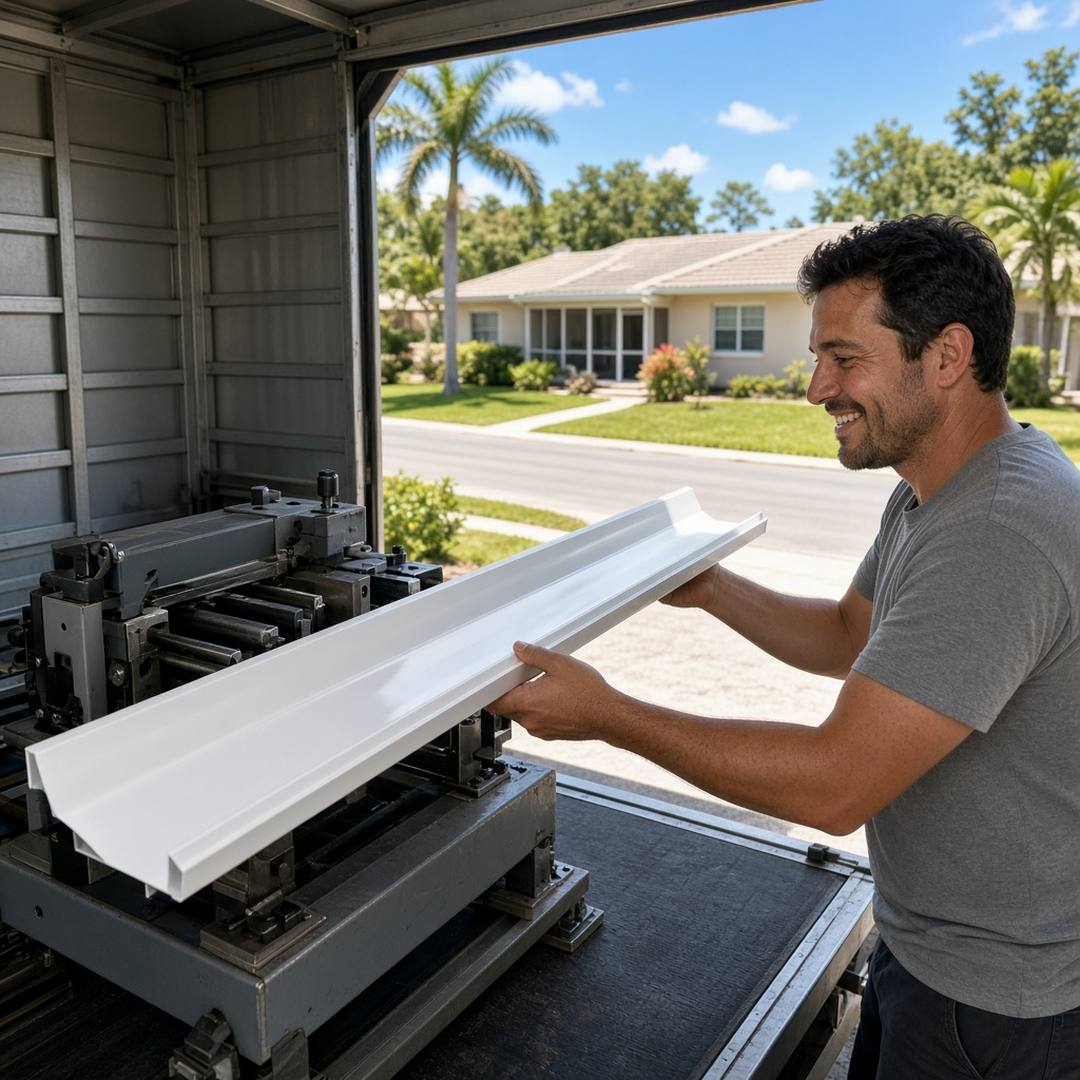
Seamless gutters are made on-site, which is the thing that sets them apart from the sectional gutters sold in 10-foot pieces at the hardware store. A single run of aluminum is formed to the exact length of each eave at the house, so the trough has no joints except at the corners and the downspout outlets. For a Florida home taking 50-plus inches of rain a year, those missing joints are the whole point — joints are where gutters leak first.
Here is how a seamless system actually comes together, from coil to finished run.
How Seamless Gutters Are Made
Seamless gutters are made from a coil of pre-finished aluminum run through a roll-forming machine mounted in the installer's truck. The machine bends the flat coil into the K-style or half-round profile and cuts it to the length called for, so a 40-foot eave gets one 40-foot gutter instead of four sections joined together. Because the aluminum is pre-finished, the color runs the full length with no painted seams to chip.
Forming on-site is why the gutter is "seamless." The only places two pieces meet are the mitered corners and the outlets where downspouts connect, and those get sealed. Everywhere else, the trough is one unbroken piece of metal.
How Seamless Gutters Are Installed, Step by Step
Seamless gutters are installed in a set sequence, and following it is what makes the system drain for years. First, the installer measures every eave and works out how many downspouts the roof area needs. Second, each run is roll-formed to length on-site. Third, hidden hangers are fastened inside the trough into the fascia board, spaced to hold through wind.
Fourth, the run is hung with a slight fall toward the outlets — roughly a quarter inch for every 10 feet — so water moves instead of standing. Fifth, the downspouts are cut, elbowed around the corners, and secured, then aimed at splash blocks or drains that carry water away from the slab. Finally, the corners and outlets are sealed and the whole system is water-tested. If you are weighing a new system, seamless gutter installation in Palm Coast runs on exactly this process.
Why On-Site Forming Matters in Florida
On-site forming matters in Florida because the climate punishes joints. The state's heavy, concentrated rain works through every seam in a sectional gutter, and the salt air near the coast speeds up corrosion at those joints. A seamless run gives the water far fewer places to escape, which is why it is the standard on coastal homes from Palm Coast down the Atlantic side.
Aluminum formed on-site also lets the installer match each run to the real roofline, including odd angles and long unbroken eaves that would need several joined pieces in a sectional system. The result is a cleaner line and a trough that drains the way it was pitched.